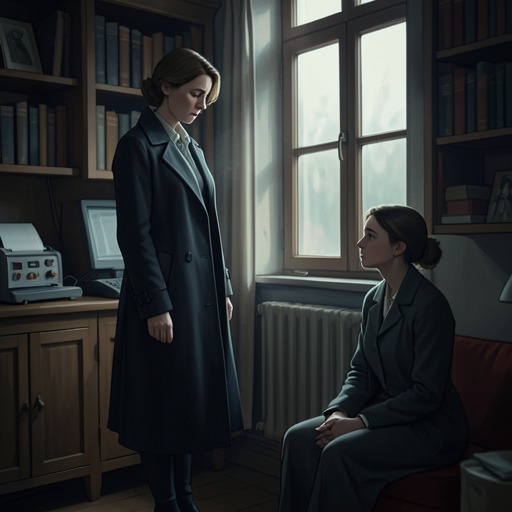
Hana Hanáková
The Glass RoomHana Hanáková is Liesel Landauer’s intimate friend, godmother to Liesel’s daughter, and one of the novel’s most socially agile and emotionally exposed characters. In the interwar years, she mediates between Czech and German, the arts and business, and the city’s overlapping social circles. Her outwardly unconventional life does not make her attachments casual: she loves, suffers, cares for Liesel through a life-threatening illness, and carries the memory of a child taken from her in Ravensbrück. Her late testimony turns private grief into an unanswerable encounter with history.
Identity and Social World
Younger than Liesel, Hana is nevertheless her close companion and frequent intermediary across the divisions of Město’s bourgeois society. The two meet every Wednesday at Café Zeman, where Hana drinks Turkish coffee, eats Sachertorte, and watches the other patrons from their accustomed corner. She is at ease in public and in the arts, but her position is not merely that of a social ornament: she connects circles that might otherwise remain separate.
Hana’s unconventional reputation is established through earlier artistic associations. She posed nude for Drtikol and, at nineteen, was painted nude in Paris by Tamara de Lempicka. A rumour that she and de Lempicka were lovers remains unconfirmed; Hana neither denies nor confirms it. The novel presents that uncertainty as part of her public image, not as proof of a relationship. Against Liesel’s insistence that marriage and a coming child are sacred, Hana argues that little remains sacred in modern life. The contrast exposes different understandings of intimacy: Liesel emphasizes marital commitment and motherhood, while Hana treats social conventions with irreverence, without being free of longing or vulnerability.
Friendship, Family, and Care
Hana’s closeness to Liesel is expressed both in talk and in practical loyalty. When Liesel is pregnant, Hana asks after the baby and seeks permission to touch her friend’s belly. The encounter becomes unexpectedly intimate; Liesel asks her to stop, and Hana withdraws. The two do not discuss the episode afterward. Its silence preserves the moment’s ambiguity rather than resolving it into a settled definition of their relationship.
Liesel later insists that Hana become her daughter’s godmother. Although Viktor objects that Hana is an unsuitable model of fidelity and modesty, Liesel defends her as her dearest friend and says that, since she was prevented from naming the baby Hana, he must allow this. The request makes their friendship part of the child’s family life, not simply a private bond between two women.
That bond is tested when Liesel gives birth to Martin by forceps delivery and develops a dangerous fever. For days she lies in hospital, sometimes delirious and sometimes barely conscious; her doctors and nurses speak as though she may not recover, and a priest is brought to her bedside. Viktor visits when he can, but Hana devotes herself to Liesel through the crisis. Once Liesel begins to recover, Viktor acknowledges that Hana has been far more than a fair-weather friend and that he does not know how he would have managed without her. Hana’s care is therefore not a passing gesture: it establishes her as a dependable presence in the family at a moment when Liesel may die.
Love, Loss, and Conflict
Hana’s devotion is not confined to her friendship with Liesel. She becomes involved with Miroslav Němec and loves him intensely, but his wife knows about the affair and eventually demands that he choose. He returns to his wife, leaving Hana with only the occasional night or brief interval together. At the Glass Room, Hana paces and weeps as she tells Liesel what has happened; their laughter briefly restores a sense of normality, but cannot remove the hurt. Liesel recognizes the contrast between her own secure-seeming life—with Viktor, two children, and the house—and Hana’s feeling that she has nothing.
Hana also tells Oskar about Němec. Rather than threaten or punish her, Oskar says he will let her go if Němec is truly the man she wants, and that he will remain to help her pick up the pieces. Hana cries not for herself or for Němec but for her husband, whose love she understands even as she has betrayed him. The scene complicates the easy image of Hana as merely promiscuous: her choices bring pain, but so does her recognition of Oskar’s generosity and devotion.
During the occupation, Hana encounters Werner Stahl, the man in charge of work at the confiscated Landauer House, and learns of his interest in racial classification. She introduces herself directly, then challenges the premise that human beings can be reduced to simple categories. Stahl invites her to be photographed for the research, saying that she would need to undress; she answers by asking whether dinner is part of their arrangement, refusing to treat his demand as an unquestionable scientific procedure. Their relationship becomes intimate, though the novel also shows the power imbalance surrounding his role and his access to the house.
When Stahl argues for isolating Jews, Hana reveals that her husband is Jewish. She makes the personal fact an explicit test of his claims, then tells him she is pregnant. Her disclosure confronts Stahl with consequences his language of classification has kept at a distance. It also links Hana’s private life to the persecutory system operating around her; the novel does not present this confrontation as a safe or abstract debate.
Exile, Testimony, and the Lost Child
Years later, during exile, Hana writes to Liesel about the delay in wartime mail: a journey of only a day by train separates them, yet Liesel’s last letter took three weeks. She describes the family’s third summer away from home as a limbo neither paradise nor hell, where time is measured by changes in the lake’s surface rather than by the familiar rhythms of home. In the same letter she reports that the Landauer House has been put to official use and that its new occupant is a young, good-looking, strange scientist. Her account carries both intimate news and the disquieting awareness that the family home has acquired another life under occupation.
In a later conversation with Zdenka, Hana remembers meeting the man who nearly destroyed her at a café table. She recalls him as a handsome young man in uniform, a perfect Aryan. The account changes as she traces what followed: the Gestapo came to her house at night and took both her and Oskar. After the war, she learned that Oskar had been sent to Theresienstadt, where he remained for about a year before being transported to Auschwitz in January 1943. Hana says that she had betrayed him many times, but that he was the only man she ever loved. Her account binds personal guilt and love to the machinery of arrest and deportation without suggesting that her betrayals explain or justify what happened to him.
Hana tells Zdenka that she herself survived Ravensbrück through luck and love. She asks Zdenka to dance for her in the Glass Room, hoping to be reminded of beauty amid memories of fear and degradation. The request connects Hana’s wartime account to Zdenka’s life as a dancer and to the house’s changed function: a space associated with modernist beauty becomes a place where a survivor asks another person to embody beauty again.
Hana’s most guarded revelation follows. She tells Zdenka that she gave birth to a girl in Ravensbrück, a fact she says she has never told anyone. The infant had dark hair and a wrinkled face; Hana named her Světla, meaning light in the darkness. The baby was put to Hana’s breast, but Hana had no milk, and the child was taken away. Hana never saw her again. She had imagined that her daughter might survive and that they could be reunited after the war; that hope became one reason to stay alive. She says that Světla saved her life, even though their reunion remained a fantasy.
Memory and Narrative Significance
Hana’s story gives material force to the novel’s contrast between abstract ideas and lived consequences. In the Glass Room, Stahl’s language of science and racial categories meets Hana’s insistence on human complexity and on the fact that her husband is Jewish. Later, Zdenka’s reflections on the denial of history are unsettled by Hana’s testimony: the memory of Ravensbrück, Oskar’s deportation, and Světla’s removal cannot be made into a harmless abstraction or dissolved into an ideal of timeless beauty.
The final revelation also changes the meaning of Hana’s long silence. Her earlier public confidence and her capacity to comfort Liesel do not mean that her own grief has been spoken or resolved. When she tells Zdenka what happened, Zdenka goes around the table and embraces her. The surrounding modernist room—glass, concrete, chrome, an onyx wall and tropical-hardwood partitions—does not erase the past; it holds the scene in which that past becomes present between two people. Hana’s narrative role is thus both relational and testimonial: she connects the Landauer family’s intimate history to persecution, survival, and loss, and makes remembrance an act of care.